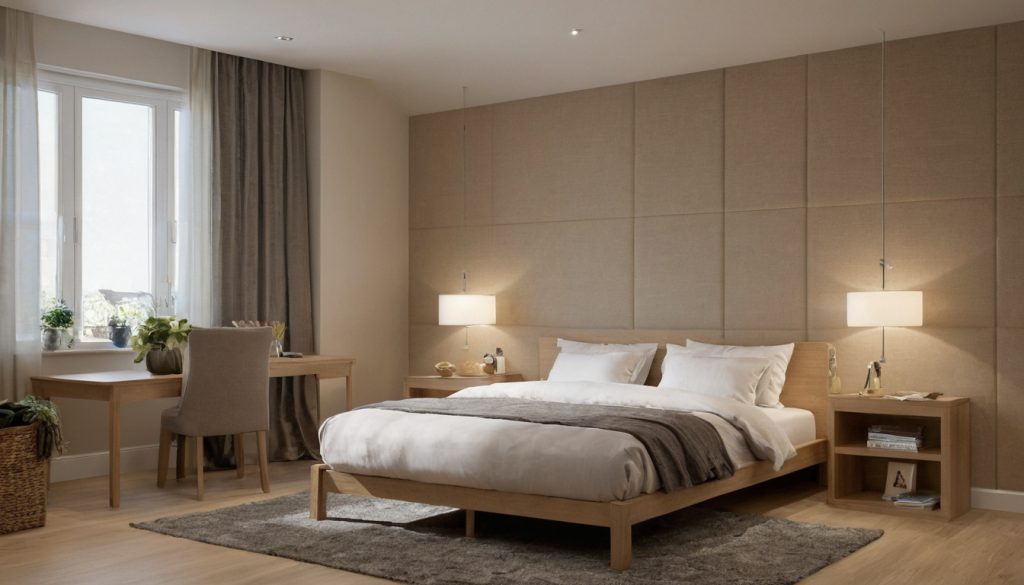
The expensive mistake appears after installation: fabric nap holds a grey film of dust, timber slats fail to reduce the noise entering through the wall, or adhesive pulls the paper face from the drywall during removal. A homeowner planning panels for walls can avoid those outcomes by treating each option as an installed assembly, not simply as bedroom decor.
Which bedroom wall panel performs best under different project constraints?
Bedroom wall panels should be compared as complete assemblies, not by surface appearance alone. In a dry, conditioned residential bedroom, upholstery favors softness, timber slats balance texture with partial absorption, MDF provides crisp detailing, and purpose-made acoustic panels offer the strongest documented absorption when the installed backing and mounting match the tested configuration.
| Panel type | Construction and fixing | Cleaning and repair | Evidence to request |
|---|---|---|---|
| Upholstered | Fabric over foam, fiber or board; commonly clipped, screwed or bonded. Clips support removal, while adhesive can tear drywall. | Fabric nap and seams retain dust. Vacuum with a suitable upholstery tool; replace a stained module if individual units remain available. | Core and textile identity, emissions, fire classification, cleaning instructions and approved fixing method. |
| Slatted wood | Timber or veneered slats, sometimes over felt, fixed with screws, battens or adhesive. Mechanical fixing improves removability. | Deep black joints collect visible dust. Vacuum between slats; repair may require replacing one slat or a full module. | Species or veneer, backing composition, finish, installation manual and acoustic test report if absorption is claimed. |
| Painted or veneered MDF | Composite-wood core installed with concealed fasteners, battens or adhesive. Edges need protection from impact and moisture. | Smooth sealed faces wipe clean, but chipped MDF edges are difficult to disguise. Confirm whether sections can be refinished or replaced. | Composite-wood compliance, coating data, expansion guidance, fire documentation and touch-up procedure. |
| Purpose-made acoustic | Porous fiber, felt, foam or fabric-covered absorptive core; fixed directly or with a specified air gap. | Textured faces collect more dust than sealed boards. Modular mounting simplifies damaged-panel replacement. | Laboratory absorption report, tested thickness, backing, air gap, mounting, emissions, fire classification and warranty. |
The panel label does not describe the complete wall assembly
Panel categories overlap. Timber slats may sit on absorptive felt, while an upholstered panel may conceal an acoustic fiber core. Decorative felt-backed slats are not automatically equivalent to a laboratory-tested acoustic assembly. The homeowner should request documents naming every visible and concealed layer, including coatings, adhesives and fasteners, because performance and warranty claims follow the specified configuration.
Field-applied adhesives and touch-up coatings also affect the bedroom environment. During application and curing, the U.S. Environmental Protection Agency advises ventilation and compliance with label precautions. In an accessible bedroom, added panel depth must also preserve circulation and the applicable 30 by 48 inch clear floor space. Those outcomes depend on the existing wall, fixing method and removal plan.
Bedroom wall-panel installation depends on the substrate and removal plan
Installation quality depends on substrate flatness, moisture condition, fixing access, panel weight and the manufacturer’s approved mounting method. On sound drywall in a dry bedroom, cleats or screws usually improve removability. Full-spread adhesive can conceal fixings, but it may tear the drywall paper and increase later repair work.
What wall preparation is required before bedroom panels are installed?
Use the manufacturer’s installation manual to make each inspection item a go or no-go decision:
- Moisture: Stop if the wall shows an active leak, condensation, damp plaster or mold. The U.S. Environmental Protection Agency advises correcting the water source and cleaning and drying affected surfaces rather than covering them with paint, caulk or panels. See the EPA moisture and mold guide.
- Surface condition: Repair loose plaster, peeling paint, unsupported drywall and prominent joint ridges. Adhesive-mounted MDF needs a sound, clean surface; rigid slatted panels may need furring or plywood backing where the wall falls outside the product’s flatness tolerance.
- Fixing support: Locate studs and confirm whether panel weight requires blocking behind drywall. Do not assume drywall anchors are suitable unless the panel manufacturer permits them.
- Installation environment: Confirm approved substrates, acclimation time, substrate dryness, room conditions and required expansion gaps. Painted drywall, masonry and plaster may need different primers or fixings.
Mechanical fixings make bedroom panels easier to remove and repair
Choose the mounting system by working backward from removal. Clip-mounted or cleat-mounted panels can often come down with limited wall repair, provided individual units remain accessible. Face screws leave fillable holes but remain visible unless concealed. Adhesive can leave residue, pull away paper facing and turn a finish change into skim coating and repainting.
- Ask whether one damaged panel or slat can be replaced independently.
- Request fixing spacing, fastener penetration and removal diagrams.
- For rented bedrooms, obtain written approval before drilling or applying adhesive.
Outlets, switches and skirting details must be resolved before panel installation
Measure the finished panel depth before cutting begins. Outlets, switches, thermostats, vents, skirting and door trim need deliberate edge details rather than narrow, chipped MDF strips or exposed acoustic backing. Where electrical boxes or devices must move forward, use a licensed electrician and follow the project jurisdiction’s requirements for box extensions, device support and access.
- Inspect and measure the wall.
- Resolve backing and service alterations.
- Set panel and trim lines.
- Cut, fix and inspect replaceable sections.
Once installation is workable, the next test is whether an acoustic panel controls bedroom reverberation or merely looks sound-absorbing without soundproofing the wall.
Acoustic wall panels reduce bedroom reverberation but do not automatically soundproof the wall
Acoustic bedroom wall panels can reduce reverberation inside a room, but they do not automatically block voices, traffic or television noise passing through a wall. A useful comparison requires independent absorption data for the exact panel thickness, backing, air gap and mounting method, while sound-isolation claims require separate evidence for the complete partition.
NRC values are comparable only when the tested bedroom-panel assemblies are equivalent
A homeowner should request the test standard, report date, laboratory identity and frequency-by-frequency absorption coefficients, not merely a headline NRC value. The report should also describe the specimen thickness, exposed area, edge treatment and mounting configuration.
| Panel assembly | Absorption evidence to check | Mounting variables | Sound-isolation evidence |
|---|---|---|---|
| Upholstered or fabric-wrapped panel | ASTM C423, ISO 354 or an applicable equivalent for the finished panel | Core density, fabric, thickness, edge construction and air cavity | None unless the complete wall was tested |
| Timber slats over felt | Report matching slat width, spacing, felt and backing | Direct fixing versus battens, cavity depth and insulation | Separate partition test required |
| Thin felt or acoustic sheet | Frequency data for the specified thickness | Adhesive fixing, mechanical fixing or installation over a cavity | Do not infer isolation from absorption data |
An air cavity can change absorption compared with direct mounting, so two visually identical slatted walls may perform differently. Lower-frequency results also matter because a panel that controls speech-range reflections may do little for bass-heavy television audio or traffic rumble.
Soundproofing concerns transmission through studs, boards, insulation, junctions and penetrations. ASTM E90 measures laboratory airborne sound transmission loss through partitions and elements, while ASTM E413 derives ratings such as STC from frequency-dependent transmission-loss data. Neither result can be assigned to an absorptive facing alone.
Where should acoustic panels be placed in a bedroom?
Acoustic panels should address reflective surfaces rather than cover a wall by habit. Before selecting coverage, record room dimensions, ceiling height, hard flooring, curtains, wardrobes and upholstered furniture. Restrained placement behind a headboard or opposite a television may improve comfort without turning every surface into walls decor. Persistent noise, unusual geometry or a measurable target warrants advice from a qualified acoustician.
In an accessible bedroom containing a desk or work surface, panel thickness and placement must not obstruct the required approach. The 2010 ADA Standards place accessible dining and work surfaces between 28 and 34 inches above the finished floor or ground where those standards apply.

Acoustic wall panels reduce bedroom reverberation but do not automatically soundproof the wall shown as an editorial planning reference.
A thin acoustic sheet is useful only when its tested assembly matches the bedroom problem
A thin sheet may soften flutter echo or speech reflections when its density, thickness and mounting match the absorption report. It is not a substitute for sealing gaps or upgrading a weak partition. Exposed felt also needs cleaning, fire and emissions documentation. Adhesives can release VOCs depending on formulation, curing and ventilation, as the EPA explains for adhesives and furnishings. Those concealed components make emissions and fire documentation the next selection test.
Bedroom wall panels require component-level emissions and fire documentation
Emissions and fire documentation should cover every component in a bedroom panel assembly, including composite-wood cores, felt, foam, fabric, coatings and adhesive. For an occupied sleeping room, request current reports naming the exact products and tested configuration, then compare them with the project jurisdiction’s adopted code and the client’s indoor-air requirements.
Composite-wood compliance does not cover every bedroom-panel emission source
Composite-wood paperwork addresses the relevant wood core, not necessarily the finished panel. For a United States project, the U.S. EPA composite-wood requirements cover regulated panels and finished goods under TSCA Title VI and 40 CFR Part 770, subject to applicable exemptions and entity-specific obligations. Other jurisdictions may require different documentation.
The client should match the certificate to the product name, core type, manufacturing location, production date and stated exclusions. A certificate for bare MDF does not establish the emissions performance of a fabric-faced panel containing foam, coating and field-applied adhesive. Request finished-product VOC emissions evidence using a method applicable to the project, plus separate evidence for textiles, coatings and adhesives if the report does not include them.
Fire classifications apply to the tested panel assembly, not a similar-looking product
Fire requirements cannot be selected from appearance or a generic material description. First identify the project country, region, building type and adopted code edition. Then obtain a report from a recognized laboratory that identifies the panel core, decorative face, substrate, adhesive, air gap, mounting method and edge condition.
ASTM E84, where accepted by the applicable code, reports comparative flame-spread and smoke-developed indices for the tested specimen and mounting method. Those results are not a complete assessment of actual fire hazard and should not be transferred automatically to a panel with different fabric, coating, adhesive or support. Other jurisdictions or installations may call for NFPA 286, EN 13501-1 or another method.
Bedroom wall panels require component-level emissions and fire documentation shown as an editorial planning reference.
Stop approval if the supplier cannot show that field-applied finishes and adhesives fall within the classification. When coverage is unclear, obtain written direction from the local code official or a qualified fire consultant. Once documentation is settled, the practical distinction becomes daily maintenance.
Smooth sealed panels are easier to clean than slatted or fabric-covered bedroom panels
Cleaning performance depends more on the exposed surface and joint geometry than on labels such as acoustic or decorative. In an ordinary bedroom, sealed MDF is usually simplest to wipe, timber slats require joint vacuuming, and fabric-covered panels need low-suction cleaning and approved spot treatment. Pets, dust sensitivities and humidity can change that ranking.
Slats, bevels and fabric textures determine how much bedroom dust is retained
Deep black joints between timber slats reveal lint quickly, while narrow gaps can prevent a standard crevice tool from reaching the felt backing. Before ordering, test the actual vacuum attachment against the slat spacing. Woven fabric and upholstery nap can hold hair or snag, so check weave durability, pile direction and cleaning instructions rather than judging only the sample’s color.

Smooth sealed panels are easier to clean than slatted or fabric-covered bedroom panels shown with practical context cues.
- Ordinary bedroom: Dust smooth surfaces and vacuum joints as visible buildup develops.
- Home with shedding pets: Choose reachable grooves, snag-resistant fabric and removable modules.
- Dust-sensitive occupant: Favor sealed, accessible surfaces and seek specialist advice before making allergy-related claims.
- Before cleaning: Confirm permitted suction, attachments, detergent and moisture levels, plus warnings about abrasion, solvents, steam, bleach, soaking and color transfer.
Can a damaged bedroom wall panel be cleaned, refinished or replaced individually?
A localized stain, chipped MDF edge or scratched veneer is manageable only if the manufacturer permits spot repair and a matching component remains available. Confirm whether paint touch-up, refinishing or reupholstering affects the warranty, and retain spare material from the same production batch where color variation matters.
Replacement also depends on access. Concealed clips may release one module, while adhesive or interlocking edges can force removal of neighboring panels and damage drywall. That repair difference belongs in the installed quotation.
Installed cost and project sequencing matter more than the bedroom panel’s unit price
Bedroom wall-panel cost should be compared as an installed, repairable system, not as a price per panel. For the same measured wall, quotations should separate preparation, alterations, labor, waste, delivery and finishing. Procurement should follow wall inspection and sample approval, while installation should precede final furniture placement and delicate cleaning.
A bedroom wall-panel quotation should expose preparation and alteration costs
Request like-for-like quotations based on the same wall dimensions, location, panel layout and finish specification. Each quotation should identify:
- Demolition, moisture correction, substrate repair and structural blocking.
- Panel quantities, cutting waste, cutouts, corners, trims and perimeter finishing.
- Outlet or switch alterations completed by an appropriately qualified tradesperson.
- Delivery, floor protection, furniture moving, installation, cleanup and spare panels.
- Exclusions involving concealed damage or hazardous-material assessment in older buildings.
- Warranty responsibility among the panel manufacturer, adhesive supplier and installer.
Order samples and inspect the bedroom wall before placing the full panel order
Use this sequence: survey the substrate, review acoustic and product documentation, approve samples under daytime and evening lighting, prepare a setting-out drawing, confirm the quotation, complete service alterations, install the panels and inspect the finished joints.
Before ordering, confirm lead time, minimum quantity, batch variation, return restrictions and the supplier’s replacement policy. Panel depth and trims can also alter bedroom furniture clearances, so position beds and dressers only after finished dimensions are known. The final safeguard is a documented panel specification and installer checklist.
Choose bedroom wall panels with a documented selection and installer checklist
The best bedroom wall panel satisfies the project’s dominant constraint without creating an unverified benefit elsewhere: tested acoustic construction for reverberation control, removable modules for reversible room decoration, or sealed MDF for durable bedroom wall decor, provided installation, emissions, fire, cleaning and cost requirements are documented.
- Acoustic objective: Specify whether the room needs less reverberation or greater sound isolation; these goals require different evidence.
- Tenancy and removal: Choose clips or accessible screws where repairable drywall and reversible room decoration matter.
- Substrate: Confirm that drywall, plaster or masonry is dry, stable, flat and able to support the panel weight.
- Dust and cleaning: Prefer sealed, smooth panels for dust-sensitive occupants; accept slats or fabric only with a realistic vacuuming routine.
- Compliance: Request emissions and fire documents covering the proposed panel, backing, finish, adhesive and mounting arrangement.
- Budget: Compare preparation, trims, electrical work, waste, installation and eventual removal rather than panel price alone.
The bedroom panel specification should name every visible and concealed component
Write the specification as a purchasable assembly: manufacturer and product reference, finish code, panel thickness, backing, edge treatment, trims, adhesive, clips, screws, touch-up material and the manufacturer’s installation instructions. State the required acoustic, emissions and fire reports, plus the evidence an alternative product must provide before substitution.
Require care instructions, warranty terms and spare panels from the same production batch at handover. Ask the installer who accepts responsibility for substrate correction, electrical coordination, setting-out tolerances, a sample installation, daily cleanup and defects that appear after completion.
Do not approve bedroom panels until these installation risks are resolved
Stop procurement or installation if any of these conditions remains open:
- The wall is damp, unstable or insufficiently flat. The U.S. Environmental Protection Agency advises drying wet or damp materials within 24 to 48 hours to help prevent mold growth; contaminated porous material may instead require removal or professional remediation.
- The panel weight, fixing pattern or adhesive is incompatible with the substrate.
- Acoustic, emissions or fire reports describe a different construction or mounting method.
- Outlets, switches, skirting, corners and panel edges lack coordinated details.
- Cleaning, individual replacement or eventual removal would cause unacceptable maintenance or wall repair.
The final choice should be the documented assembly the owner can install, maintain and remove with understood consequences, not the most persuasive sample on the mood board.

Choose bedroom wall panels with a documented selection and installer checklist shown as an editorial planning reference.
Frequently asked questions about bedroom wall panels
What are the disadvantages of acoustic wall panels in a bedroom?
Acoustic panels can retain dust, reduce usable wall depth and require careful fire and emissions checks. They also control reflections rather than automatically blocking transmitted noise. Fabric, felt, air gaps and mounting hardware increase the number of components that must match the tested assembly.
Will slatted or upholstered bedroom wall panelling look outdated in 2026?
Longevity depends less on the year than on proportion, detailing and replacement difficulty. Restrained coverage, clean perimeter trims and materials suited to the room usually age better than a full decorative treatment built around a short-lived color or exaggerated slat pattern.
Should you install an acoustic sheet on a bedroom wall to reduce noise?
Install an acoustic sheet only if the problem is room reverberation and its tested mounting configuration suits the wall. A thin sheet will not correct sound entering through gaps, doors, outlets or a lightweight partition.